Asked about the oil tank
What do we do if heating oil leaks?
Answered by Asked in Ayrshire · Updated · Sources at the foot
If heating oil leaks, keep people and pets away, keep oil out of drains and burns, call SEPA straight away if it could reach water, then ring your insurer.
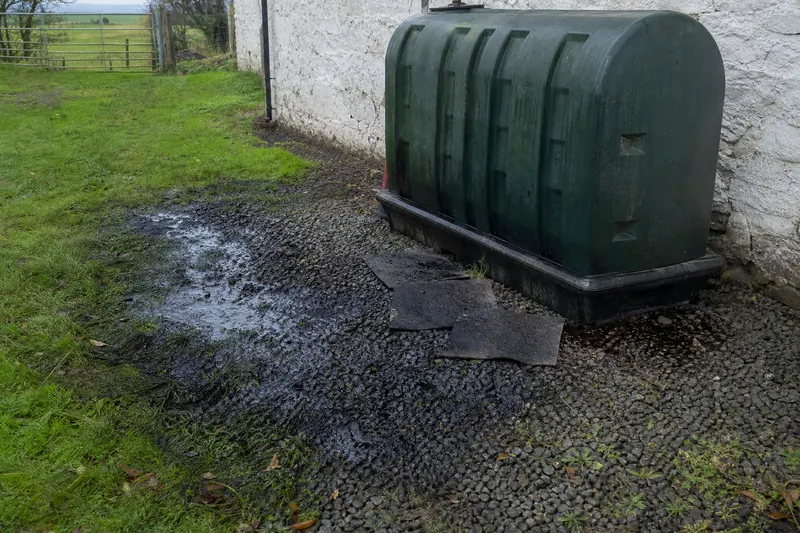
A leak usually shows as a paraffin smell, a stain round the tank base or a sudden drop on the gauge.
The steps below follow SEPA's own guide, How to deal with domestic oil spills, which SEPA says is advice for householders with no legal status. It tells you to act quickly.
What should we do in the first hour?
Keep children and pets away from the spill, and keep oil off your skin and clothes. If there is an oil smell indoors, SEPA's guide says to open windows and doors and contact your council's environmental health department for advice.
SEPA's guide says to switch off the oil supply at the tank and find where the leak is coming from. Do that only if it is safe and easy to reach, by closing the valve where the pipe leaves the tank; never climb on the tank. Then stop the oil spreading. SEPA suggests absorbent material such as earth, sand or cat litter, and above all keeping oil out of drains and waterways.
When do we have to tell SEPA?
If oil has reached or could reach a drain, burn, ditch or groundwater, call SEPA's pollution hotline on 0800 80 70 60 straight away; then ring your insurer. SEPA's guide says you must contact SEPA if oil has entered, or could enter, drains or the water environment. SEPA's reporting page says a live operator answers between 8am and 6pm, Monday to Friday, and SEPA's contact page says that outside those hours an automated system triages reports and escalates urgent ones.
SEPA's guide also lists Scottish Water and your council's environmental health department as contacts, and warns against drinking the water if your supply or pipes may have been affected. On a spring or well, wait for the council's advice; see who tests a private water supply.
Who cleans it up?
Next, ring your insurer (after SEPA, if water could be affected). If your policy covers it, the insurer usually appoints a specialist spill contractor. SEPA's guide says contaminated soil and water will need cleaning up, and that you or your contractor will need to ask SEPA about safe disposal. It advises against trying the clean-up yourself because of the health risks and specialist nature of the work.
Any oil left in a damaged tank has to be moved out by the supplier or contractor. Repairing or replacing the tank, its pipes or its valves is work for an OFTEC-registered technician.
Why do tanks leak in the first place?
SEPA's guide gives the common causes: failures of the tank body, damaged fittings such as sight gauges, worn fuel lines, and failures at the boiler end such as flexible hoses.
OFTEC's tank-check advice suggests looking for cracks, splits, bulging or discolouration on plastic tanks, rust on steel ones, and oil stains or damp patches round the base and pipework. The age question is covered in how long a plastic oil tank lasts.
How do we lower the risk next time?
SEPA's guide suggests being present when the tank is filled, checking the tank by eye every month, noting any sudden drop in level, and keeping your insurer's spill guidance near the boiler or tank. A tank near water may also need a bund under the building standards on fuel containment; see does my oil tank need a bund.
What to look at first
- Where the oil is going: towards a drain, ditch, burn or field drain?
- Whether anyone has oil on their skin, or there is a smell indoors.
- The tank gauge and the date of your last delivery, to estimate how much is lost.
- Your insurance policy: does it cover oil spills and clean-up?
Yours to do, and theirs
You can
- Keep people and pets away and open windows if the smell is indoors.
- Pen in the spill with earth, sand or cat litter and keep it out of drains.
- Call SEPA on 0800 80 70 60 first if oil could reach water, then ring your insurer.
Leave to them
- Stopping a leak from the tank body, and any repair or replacement, is for an OFTEC-registered technician.
- Cleaning up contaminated ground is for a specialist spill contractor, with disposal advice from SEPA.
| Who | When | Why |
|---|---|---|
| SEPA pollution hotline | Straight away, if oil has reached or could reach a drain, burn, ditch or groundwater | Pollution of the water environment |
| Your insurer | Next, as soon as you can | They may appoint a spill contractor |
| Council environmental health | Smell indoors, or water supply or pipes may be affected | Health advice and private supplies |
| Scottish Water | Oil may have reached drains or the mains supply | Listed as a contact in SEPA's guide |
Safety first
Never climb on, cut, drill, pump out or try to patch an oil tank. Don't wash oil away with water or detergent, and don't drink water from a private supply that oil may have reached until the council says it is safe.
In short
Keep oil out of drains and burns and keep people away. If oil has reached or could reach a drain, burn, ditch or groundwater, call SEPA on 0800 80 70 60 straight away, then ring your insurer. Leave the tank and the clean-up to an OFTEC-registered technician and a specialist contractor.
Also asked about this
Is a drip from the hose under the boiler a leak too?
Yes. SEPA lists flexible hoses at the boiler end as a common source.
Should we keep running the boiler while the tank is leaking?
SEPA's guide says to switch off the oil supply at the tank; do it only if the valve is safe and easy to reach. Leave the heating off until an OFTEC-registered technician has checked the system.
Can we put the oil-soaked earth in the bin?
No. SEPA's guide says to ask SEPA about safe disposal of contaminated soil, which is usually arranged by the clean-up contractor.
Does home insurance cover an oil leak?
It depends on the policy. SEPA's guide urges householders to check their cover before anything goes wrong.