Asked about the oil tank
Does my oil tank need a bund?
Answered by Asked in Ayrshire · Updated · Sources at the foot
Your oil tank needs a bund in Scotland if it holds more than 2,500 litres, or if a smaller house tank sits near water, an open drain, a spring or borehole, or another spill hazard.
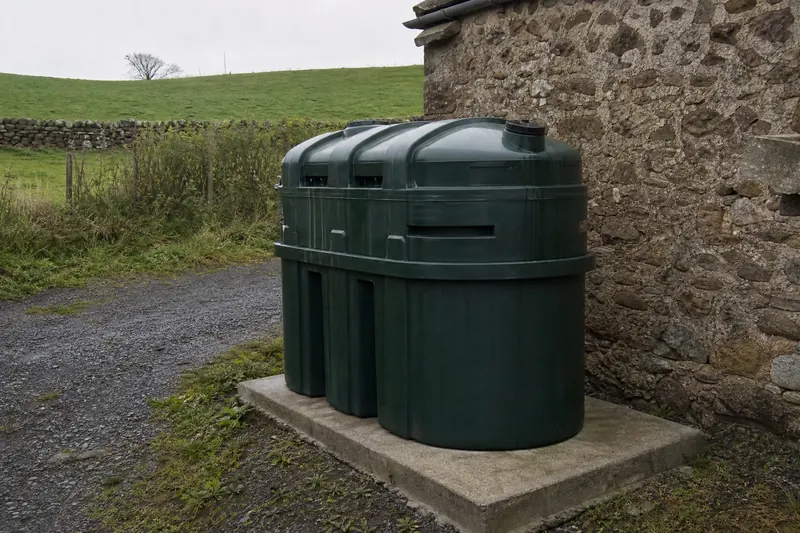
A bund is a second skin around the tank that catches oil if the inner tank splits. It can be built into the tank (an "integrally bunded" tank) or be a separate walled catchpit with no drain.
Most Ayrshire house tanks hold well under 2,500 litres, so the answer usually turns on where the tank sits.
What does the law say for a house tank?
Since 1 November 2025, SEPA has regulated water activities under the Environmental Authorisations (Scotland) Regulations 2018, which replaced the Controlled Activities Regulations (CAR). For a house tank of 2,500 litres or less that only serves the heating or cooker, SEPA's general binding rule on storage of oil on a private dwelling applies. It says the container must be strong enough that it is unlikely to burst or leak in ordinary use, and that any container installed or altered must meet the applicable regulations under the Building (Scotland) Act 2003. No application to SEPA is needed.
A house tank over 2,500 litres falls outside that rule and under SEPA's rule for all other storage of oil. That asks for a secondary containment system with a capacity of not less than 110% of the container's storage capacity, or 25% of the total where there are several containers, whichever is greater. SEPA enforces these rules.
When does a smaller tank need one?
The building standards list the situations. Under clause 3.24.3 of the Technical Handbook (Domestic), standard 3.24, an outdoor, above-ground house tank of up to 2,500 litres should have a catchpit or be integrally bunded if any of these apply:
- it is within 10m of the water environment, such as a river, loch or coastal water;
- a spill could reach an open drain or a loose-fitting manhole cover;
- it is within 50m of a borehole or spring;
- oil could run across the ground into a watercourse;
- the vent pipe outlet cannot be seen from the fill point;
- there is any other hazard particular to the site.
A tank inside a building, or wholly below ground, needs secondary containment too. On many Ayrshire properties a nearby spring is enough to put the tank on that list; check whether you have a private water supply.
How big does the bund have to be?
A catchpit must hold 110% of the tank's capacity, with a base and walls that oil and water cannot pass through, and no drain. That definition sits in the same handbook section. The tank should be built to a recognised standard such as OFTEC's OFS T100 for plastic or OFS T200 for steel.
This guidance is in the April 2026 edition of the Technical Handbook (Domestic), which applies to building warrants submitted on or after 6 April 2026.
Who decides on our tank?
An OFTEC-registered technician will assess the site when a tank is fitted or replaced. OFTEC's guide to liquid fuel heating says tanks near a river, well or other controlled water typically need bunding, and that in Scotland you may need a building warrant.
Unsure about an old single-skin tank? Ask at the next service. Siting rules for fire are on how close an oil tank can be to the house, and age is covered in how long a plastic oil tank lasts.
What to look at first
- The tank's label: its capacity in litres and whether it says "bunded".
- Distance to the nearest burn, ditch, loch or shore.
- Any spring, well or borehole within 50m.
- Drains or manhole covers a spill could run into.
- Whether you can see the vent pipe from where the tanker fills.
Yours to do, and theirs
You can
- Read the label and measure the distances to water, drains and any spring.
- Note any rainwater sitting inside an open catchpit and mention it at the service.
Leave to them
- Assessing, supplying and fitting a tank or bund is for an OFTEC-registered technician.
- Questions about a building warrant go to your council's building standards service.
| Situation | Bund or catchpit needed? | Where the rule comes from |
|---|---|---|
| Within 10m of a river, loch or coastal water | Yes | Technical Handbook clause 3.24.3 |
| Within 50m of a borehole or spring | Yes | Technical Handbook clause 3.24.3 |
| Spill could reach an open drain | Yes | Technical Handbook clause 3.24.3 |
| Vent pipe not visible from the fill point | Yes | Technical Handbook clause 3.24.3 |
| None of the above, dry open site | Not required by the list | Technical Handbook clause 3.24.3 |
Safety first
If a bund has filled with oil, or the tank is leaking, keep oil out of drains and burns and follow what to do if heating oil leaks. Never climb on, cut or try to repair the tank yourself.
In short
House tanks of 2,500 litres or less need a bund in Scotland when they sit near water, drains, a spring or borehole, or where the vent cannot be seen from the fill point. Anything bigger falls under SEPA's rule for other oil storage, which asks for secondary containment of at least 110% of the tank's capacity. An OFTEC-registered technician assesses this when the tank is fitted.
Also asked about this
Is a bunded tank the same as a double-skinned tank?
In everyday use, yes. The handbook treats an integral bund and a separate catchpit as two ways to meet the same need.
Our old tank sits on a brick plinth with no bund. Do we have to replace it now?
The handbook guidance applies when a tank is installed or altered. Ask your OFTEC-registered technician whether the current tank is still in good order and what a replacement would need.
Does a bund need a drain to let rainwater out?
No. The handbook describes a catchpit as having no drain, so rain in an open bund should be dealt with by a technician, not by drilling an outlet.
Who checks that a tank meets the rules?
SEPA enforces the oil storage rules, and the council's building standards service deals with any building warrant.
Sources, checked 5 November 2026
- SEPA — Storage of oil on a private dwelling (general binding rule)
- SEPA — All other storage of oil (general binding rule)
- SEPA — Water activities (EASR)
- NetRegs — EASR authorisations in Scotland
- Scottish Government — Technical Handbook (Domestic), April 2026, 3.24 Fuel storage – containment
- Scottish Government — Technical Handbook (Domestic), April 2026, 3.23 Fuel storage – protection from fire
- OFTEC — Your home guide to liquid fuel heating