Asked about the oil tank
How do we stop heating oil being stolen?
Answered by Asked in Ayrshire · Updated · Sources at the foot
To help stop heating oil being stolen, lock or cage the tank, light it, fit a level alarm, keep it in view of the house, and watch the gauge so a sudden drop shows quickly.
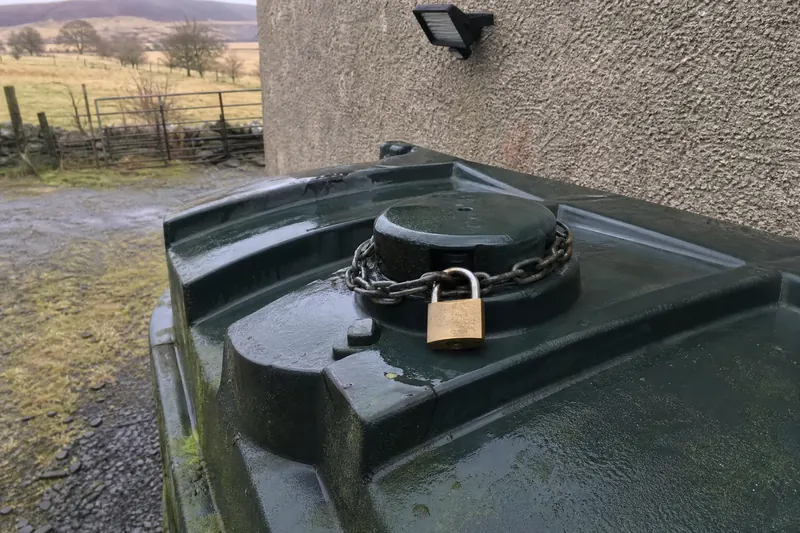
A full tank at the end of a farm road, out of sight of the house, is an easy target. Often the first sign is a gauge that reads lower than it should, or a boiler that cuts out.
No single measure stops a determined thief. The aim is to make your tank slower, noisier and more visible to raid than the next one.
What does Police Scotland advise?
Police Scotland's appeal after a heating fuel theft gave three short pieces of advice: lock your tank if possible and install suitable lighting or CCTV; site the tank, if you can, where it can be seen from a lived-in building; and consider a fuel tank alarm or monitoring system that can tell you about a theft. It asked anyone with information to contact 101.
For a theft happening now, call 999. For one you discover afterwards, call 101.
Is a padlock enough on a plastic tank?
Often not. OFTEC's guidance on avoiding heating fuel thefts says the inspection cap usually has eyelets for a padlock, and that a good closed-shackle padlock helps prevent casual theft and is particularly recommended for steel tanks.
With plastic tanks, OFTEC warns, thieves may simply bore a hole in the side, ruining the tank and possibly causing a fuel leak. It suggests a lockable cage around a plastic tank as a more expensive but effective alternative, and putting the other measures first.
Which other measures help?
OFTEC lists motion-activated security lighting, CCTV, and electronic fuel gauges that alert you if the level drops suddenly, along with a sign saying the tank is alarmed. It also suggests neighbours keep an eye out for each other, through a neighbourhood watch group if there is one.
Screening the tank with a fence, wall, plants or trellis can help hide it from the road, OFTEC says, but you must leave room for servicing and deliveries and still meet fire-safety rules. In Scotland those rules are in standard 3.23 of the Technical Handbook (Domestic): a fire barrier near a house must be non-combustible, so a timber screen is no substitute. See how close an oil tank can be to the house.
How do we know if oil has been taken?
Read the gauge after each delivery and every week or so through the winter. SEPA's domestic oil spill guide also tells householders to note any sudden drop in level, or a boiler that starts cutting out; that check catches leaks as well as theft.
If the boiler has stopped because the tank was emptied, have an OFTEC-registered technician check the system before it runs again; see who should service the oil boiler.
What if the thieves damaged the tank?
A drilled or cut tank is a spill as well as a theft. Keep oil out of drains and burns, ring your insurer, and report to SEPA if water could be affected, as set out in what to do if heating oil leaks.
What to look at first
- Can the tank be seen from a window you use every day?
- Is the fill cap lockable, and is it locked?
- Is there lighting that covers the tank at night?
- Do you know the level after your last delivery?
- Is there a gap round the tank for deliveries and servicing?
Yours to do, and theirs
You can
- Fit a closed-shackle padlock to a steel tank's cap and check the gauge regularly.
- Add movement-sensor lighting from a plug-in or battery unit, or ask an electrician to wire it.
- Report a theft to Police Scotland on 101, or 999 if it is happening now.
Leave to them
- Moving the tank, building a cage or fitting a remote level gauge into the tank is for an OFTEC-registered technician.
- Wired outdoor lighting or CCTV is for a qualified electrician.
| Measure | Best for | Watch out for |
|---|---|---|
| Closed-shackle padlock | Steel tanks | Thieves may drill a plastic tank instead |
| Lockable cage | Plastic tanks | Must leave room for deliveries and servicing |
| Movement-sensor light or CCTV | Any tank | Outdoor wiring is an electrician's job |
| Level alarm or remote gauge | Any tank | Fitting into the tank is a technician's job |
| Siting in view of the house | New or moved tanks | Fire distances still apply |
Safety first
If a tank has been drilled or cut, treat it as an oil spill: keep oil out of drains and burns and don't climb on or try to patch the tank. Don't confront anyone taking oil; call 999.
In short
Lock a steel tank, cage a plastic one, light it, alarm it and keep it in view of the house. Check the gauge often so a theft or a leak shows quickly, and report thefts to Police Scotland on 101, or 999 if it is happening.
Also asked about this
Will our insurer pay for stolen heating oil?
That depends on the policy wording, so check it before winter, and report any theft to the police.
Does a tank alarm need to be fitted by a professional?
Anything that goes into the tank itself, such as a level sensor, is for an OFTEC-registered technician. OFTEC also suggests a sign saying the tank is alarmed.
Can we hide the tank behind a hedge?
OFTEC says screening with plants can help, as long as there is room for deliveries and servicing and the fire-safety rules are met.
Who do we tell about suspicious vehicles near tanks?
Police Scotland on 101, or 999 if a theft is happening. OFTEC also suggests neighbours watch out for each other.
Sources, checked 5 November 2026
- Police Scotland — Appeal after heating fuel stolen in Kirkwall
- OFTEC — Guidance on avoiding heating fuel thefts
- Scottish Government — Technical Handbook (Domestic), April 2026, 3.23 Fuel storage – protection from fire
- SEPA — How to deal with domestic oil spills: quick guide
- OFTEC — Your home guide to liquid fuel heating