Asked about the septic tank
How often should a septic tank be emptied?
Answered by Asked in Ayrshire · Updated · Sources at the foot
A septic tank should be emptied, or de-sludged, at least once a year according to SEPA, and more often if the tank is small for the household or the maker says so.
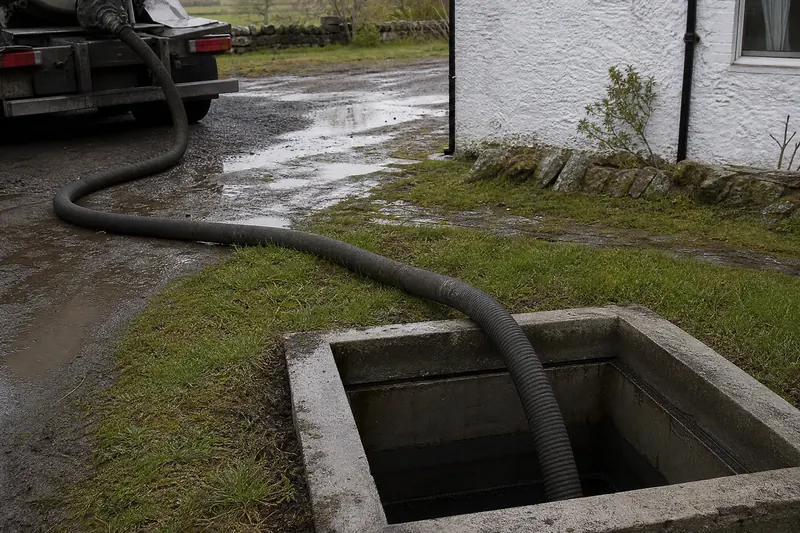
Emptying is the single biggest thing you can do to keep a septic tank and its soakaway healthy. Sludge builds up in the bottom of the tank, and if it isn't removed it starts to wash out with the liquid and clog the ground beyond.
The tank itself gives little warning. By the time you notice smells or slow drains, the soakaway may already be suffering.
What does SEPA actually say?
SEPA's maintenance guidance says to empty or de-sludge your system regularly or at least once a year. SEPA's main septic tank page puts it as simply "de-sludge annually".
Keeping the system working also matters legally. Since 1 March 2026, SEPA's standard conditions require the treatment system and outfall pipe to be maintained so they are fully functioning. See registering your septic tank for the background.
Can it ever need emptying more often?
Yes. The domestic Technical Handbook guidance on treatment plants (clause 3.8.6) says desludging frequency depends on the tank's capacity and the amount of waste going in, and advises asking the manufacturer or the desludging contractor.
A busy family home, a holiday let that fills up in summer, or an old undersized tank will usually need more frequent visits than a couple on their own. A package treatment plant has its own servicing schedule from the maker.
Who should do the emptying?
A registered waste carrier with a tanker, never the householder. Septic sludge is waste, and SEPA's public register of waste transporters lets you check a firm's authorisation before you book.
The same handbook clause expects a clear route for the hose, with the tanker standing no more than 25 metres from the tank and no more than 4 metres above its invert level. On steep Ayrshire hill ground or behind a narrow farm track, tell the carrier about access when you book.
What should we check between visits?
For treatment plants, clause 3.8.6 of the Technical Handbook (Domestic), April 2026, says they should be inspected monthly to check they are working correctly, with the effluent at the outlet free flowing. Checking inside is for the plant's service technician or the licensed carrier. Never open, enter or lean into a tank or chamber yourself; look only from the ground at what is already visible, such as pooling over the soakaway, slow drains or smells.
SEPA's maintenance guidance adds checking that soakaways drain properly and that there are no pools of sewage or blockages. Our page on a failing soakaway covers the signs, and what can go down the drain helps the tank last longer between visits.
What to look at first
- The date of the last empty and the carrier's paperwork.
- Pooling or sewage on the ground over the soakaway, seen from the ground.
- Any smell, slow drains or gurgling in the house.
- Wet or green patches over the soakaway.
- A clear tanker route within 25 metres of the tank.
Yours to do, and theirs
You can
- Book an empty at least once a year and keep the receipts.
- Check the carrier's authorisation on SEPA's public register.
- Watch from the ground for pooling, slow drains or smells, and never open a cover.
Leave to them
- A registered waste carrier empties the tank and takes the sludge away.
- An accredited service technician services a package treatment plant.
- SEPA deals with any pollution from the tank or outfall.
| Task | How often | Who |
|---|---|---|
| De-sludge the tank | At least once a year (SEPA) | Registered waste carrier |
| Inspect a treatment plant and its outlet | Monthly (Technical Handbook 3.8.6) | Service technician or licensed carrier |
| Watch for pooling over the soakaway | Regularly (SEPA) | Householder, from the ground only |
| Service a package treatment plant | As the maker instructs | Accredited service technician |
Safety first
Never open, enter or lean into a septic tank or chamber. Look only from the ground at what is already visible, and ask the licensed carrier or service technician to check inside. Gases in the tank can overcome a person in seconds; keep children and dogs away while the carrier has it open.
In short
SEPA's guidance is to de-sludge at least once a year, and more often for a small tank or a busy house. Use a registered waste carrier, keep the receipts, and watch from the ground for pooling, slow drains or smells.
Also asked about this
Should the tank be refilled with water after emptying?
Ask the carrier, who knows your tank type. SEPA's guidance also warns that restarting a treatment plant carelessly can cause pollution.
Do bacteria additives mean we can empty it less often?
SEPA's guidance doesn't mention additives and still says at least once a year, so don't rely on them to skip an empty.
Does a shared tank need one empty or one per house?
One tank needs one empty, but SEPA expects shared systems to share maintenance duties, so agree who books and pays.
What if the tanker can't reach the tank?
Tell the carrier when booking. Longer hoses may help, but the Technical Handbook's 25-metre guide shows why access matters.
Sources, checked 5 November 2026
- SEPA — Maintaining your private sewage treatment system
- SEPA — Septic tanks and private sewage treatment systems
- SEPA — Existing sewage discharge authorised by a CAR registration on 31 October 2025
- Scottish Government — Technical Handbook (Domestic), April 2026, 3.8 Private wastewater treatment systems, treatment plants
- SEPA — Find waste transporters and brokers