Asked about the septic tank
How do we tell if the soakaway is failing?
Answered by Asked in Ayrshire · Updated · Sources at the foot
A soakaway is usually failing when the ground over it stays wet or pools with sewage, there is a smell outside, the grass there is unusually lush, or the drains in the house slow and gurgle.
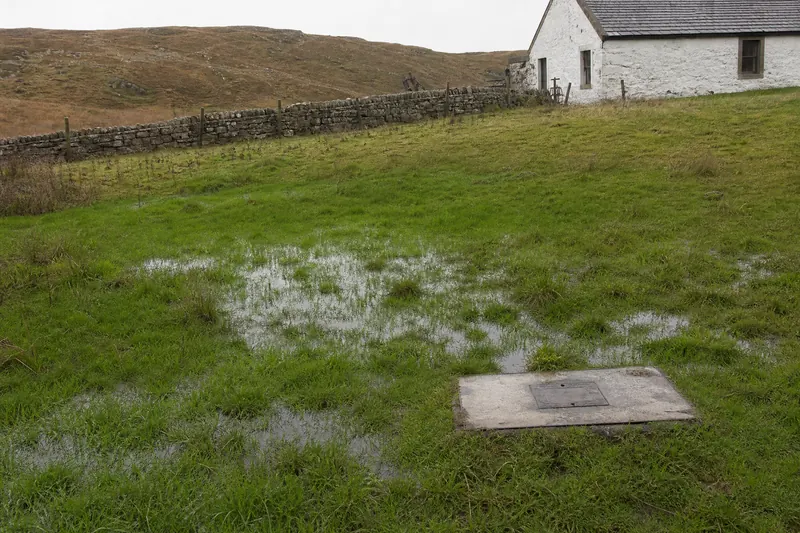
The soakaway, also called an infiltration field or drainage field, is the network of pipes that lets the liquid from a septic tank seep into the ground. It does most of the treatment work, and when it struggles the whole system backs up.
Heavy Ayrshire clay, a high winter water table and years without emptying are hard on soakaways. Spotting trouble early gives you more choices and less mess.
What are the warning signs outside?
Pooling is the clearest one. SEPA's maintenance guidance asks owners to check that soakaways drain properly and watch for pools of sewage or other blockages.
Other signs worth noting are a sewage smell near the field, ground that stays soggy in dry weather, and grass over the pipe runs that is greener and faster-growing than the rest of the paddock. If effluent is reaching a ditch or burn, that's pollution, and SEPA needs to know.
What are the signs inside the house?
Slow sinks, baths and toilets, gurgling in the pipes, and smells from plugholes can all mean the tank and soakaway aren't taking water away. These can also be a simple blockage, so start by checking when the tank was last emptied.
A full tank pushes sludge out into the soakaway, and that sludge clogs the soil. An empty is often the first step a contractor will suggest.
Why do soakaways fail?
The Scottish Government's Technical Handbook guidance on infiltration systems (standard 3.9) says problems commonly come from poor location, poor drainage field design or lack of maintenance.
Design rules for new fields show what the ground needs: groundwater and bedrock at least 1 metre below the pipes, a field at least 5 metres from a building and boundary, 10 metres from any watercourse and 50 metres from a spring, well or borehole used for drinking water. Older Ayrshire systems often predate these, and a soakaway uphill of a farm spring is a particular worry, as our water supply pages explain.
What can we do about it?
Cut the water going in. SEPA says to keep rainwater and run-off out of the system, because extra water can cause a pollution incident, and to let only toilet waste and washing water in. Check that roof downpipes don't feed the tank, and spread out washing machine loads. See what can go down the drain.
If the field has failed, a replacement or a different system may be needed, and some changes, such as moving the outfall more than 10 metres or switching from a soakaway to a watercourse, need a new SEPA registration under its rules for changes. Ask the council's building standards team too, as new fields are designed to the Technical Handbook.
What to look at first
- When was the tank last emptied?
- Are there wet patches, pooling or a smell over the soakaway?
- Do roof downpipes or yard drains run into the tank?
- Is anything reaching a ditch or burn?
- Are sinks and toilets slow or gurgling?
Yours to do, and theirs
You can
- Book an empty if it's overdue, and note what you see before and after.
- Keep people, children and animals off wet ground over the field.
- Divert roof water away from the tank if a builder confirms it goes in.
Leave to them
- A drainage contractor surveys the field and tests the ground.
- The council's building standards team advises on any warrant for a new field.
- SEPA deals with pollution and any change to the registration.
| Sign | Possible cause | First step |
|---|---|---|
| Sewage pooling on the surface | Soakaway blocked or overloaded | Book an empty, call a drainage contractor |
| Lush green strips over the pipes | Effluent near the surface | Watch it, check emptying date |
| Slow, gurgling drains | Full tank or blocked pipe | Empty, then investigate |
| Effluent in a ditch or burn | Discharge polluting water | Report to SEPA |
Safety first
Keep off ground where sewage is pooling and wash hands after any contact. Never open, enter or lean into the tank or distribution chambers. Look only from the ground at what is already visible, such as pooling over the soakaway, slow drains or smells, and ask the licensed carrier or service technician to check inside. To report pollution reaching a burn, use SEPA's report form or pollution hotline, 0800 80 70 60.
In short
Pooling, smells, soggy or lush ground over the pipes and slow drains are the usual signs. Empty the tank, keep surface water out, and get a drainage contractor to look; report anything reaching a burn to SEPA.
Also asked about this
Can a soakaway be cleaned out rather than replaced?
Sometimes, depending on the cause and the ground. A drainage contractor can tell you after a survey.
Why does the soakaway struggle every winter?
A high winter water table can leave little unsaturated soil under the pipes; the Technical Handbook expects at least 1 metre for new fields.
Can we switch to discharging into the burn?
Changing from a soakaway to a watercourse needs a new SEPA registration, and usually better treatment, so ask SEPA first.
When should we use SEPA's hotline instead of the online form?
SEPA says use the online form from 8am to 6pm, and the hotline outside those hours for ongoing, significant pollution or to report anonymously.
Sources, checked 5 November 2026
- SEPA — Maintaining your private sewage treatment system
- Scottish Government — Technical Handbook (Domestic), April 2026, 3.9 Private wastewater treatment systems, infiltration systems
- SEPA — Making a change to your private sewage registration
- SEPA — Report an environmental event
- SEPA — Septic tanks and private sewage treatment systems