Asked about the septic tank
Septic tank or treatment plant: what is the difference?
Answered by Asked in Ayrshire · Updated · Sources at the foot
A septic tank and a treatment plant differ mainly in how well they clean sewage: a septic tank settles solids for basic treatment, while a treatment plant uses biological treatment to a much higher standard.
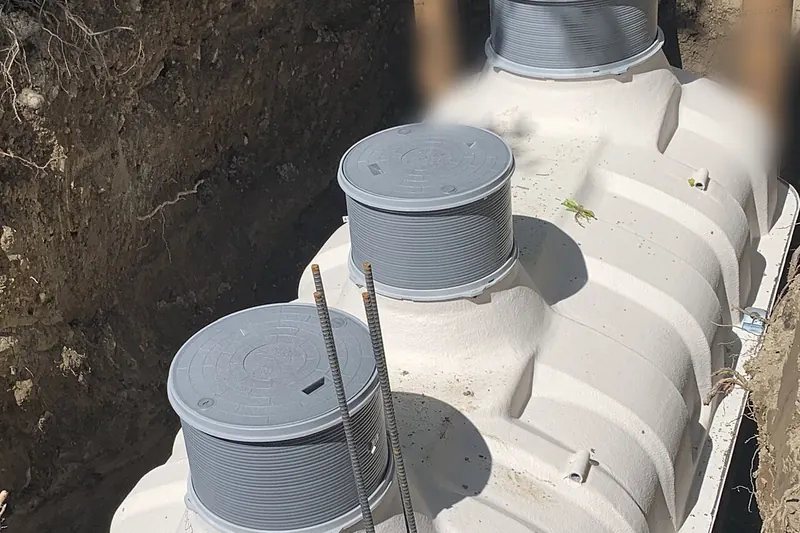
Most older Ayrshire farmhouses and cottages were built with a septic tank, often a brick or concrete chamber that has been in the ground for decades. Newer homes and many replacements use a package treatment plant instead.
Both sit between the house and a soakaway or outfall, and both need SEPA authorisation. The difference is in what happens inside and how clean the water is when it leaves.
What does a septic tank do?
It lets sewage settle. Solids sink as sludge, fats float as scum, and the partly treated liquid flows out to a soakaway where the soil does much of the remaining work. The Scottish Government's Technical Handbook guidance (clause 3.8.0) describes a septic tank as a basic form of treatment plant.
A septic tank has no moving parts and doesn't need electricity, which suits remote steadings. It does rely on a good soakaway, and it needs emptying at least once a year under SEPA's guidance.
What does a treatment plant do differently?
It adds biological treatment, usually with air pumped in to help bacteria break the sewage down. The same handbook clause says biological plants treat wastewater to a much higher standard than septic tanks, which allows a smaller infiltration field.
A package treatment plant is a factory-made unit installed with minimal site work. SEPA's maintenance guidance says to maintain it following the manufacturer's instructions, have it serviced by an accredited service technician listed by British Water, and fix leaks, pump failures or warning-light faults as soon as possible.
Which one suits our ground?
It depends on how fast the ground drains. Under standard 3.9 of the Technical Handbook, a percolation test sorts ground into bands. Normal ground suits a piped infiltration trench; slow ground needs a reed bed, constructed wetland or proprietary filter; very slow ground needs a mound filter or a system without infiltration.
On Ayrshire's heavy clays, a plant's cleaner effluent and smaller field can make the difference. Wherever it goes, the handbook expects every part of the tank or plant to be at least 5 metres from a dwelling and from a boundary.
Do we need to tell SEPA if we upgrade?
Not for a straight upgrade. SEPA's guidance on changes says you don't need to apply if you improve treatment, for example by replacing a septic tank with a package treatment plant, or replace a system with one giving the same treatment.
Going the other way, from a plant to a septic tank, means contacting SEPA's water permitting team. Changing from a soakaway to a burn, or moving the outfall more than 10 metres, needs a new registration. If your soakaway is the problem, see how to tell if it is failing.
What to look at first
- Is your system a plain tank, or does it have a blower, pump or control box?
- Where does it discharge: soakaway, ditch or burn?
- How well does the ground drain in winter?
- Is there a power supply where a plant would sit?
- What does your SEPA registration say about the system?
Yours to do, and theirs
You can
- Find out which system you have and where its outfall goes.
- Keep the plant's alarm and blower area clear and listen for changes.
- Keep servicing and emptying records together.
Leave to them
- An accredited service technician services a package treatment plant.
- A drainage contractor runs percolation tests and designs a new system.
- SEPA confirms whether a change needs a new registration.
| Feature | Septic tank | Package treatment plant |
|---|---|---|
| Treatment | Basic settlement | Biological, much higher standard |
| Power | None needed | Needs electricity for blower or pump |
| Infiltration field | Larger | Smaller, per the Technical Handbook |
| Servicing | Empty at least yearly | Maker's schedule, accredited technician |
Safety first
Never open, enter or lean into a septic tank or chamber. Look only from the ground at what is already visible, such as pooling over the soakaway, slow drains or smells, and ask the licensed carrier or service technician to check inside. Gases can overcome you quickly. Leave the electrics on a treatment plant to an electrician or the service technician.
In short
A septic tank settles sewage for basic treatment; a treatment plant cleans it biologically to a much higher standard and suits poorer ground. Upgrading from tank to plant doesn't need a new SEPA registration, but other changes may.
Also asked about this
Is a treatment plant always better?
It treats to a higher standard, but it needs power, servicing and attention to alarms. On a remote site with good ground, a well-kept septic tank can still do the job.
What happens if the power goes off to a plant?
Treatment stops working properly. SEPA warns that restarting systems can cause a pollution incident, so ask an accredited technician if unsure.
Can we add a bedroom without telling SEPA?
SEPA says adding rooms or toilets to a domestic property doesn't need a change to your registration.
Does a new plant need a building warrant?
Ask the council's building standards team, since new systems are designed to standards 3.8 and 3.9 of the Technical Handbook.
Sources, checked 5 November 2026
- Scottish Government — Technical Handbook (Domestic), April 2026, 3.8 Private wastewater treatment systems, treatment plants
- Scottish Government — Technical Handbook (Domestic), April 2026, 3.9 Private wastewater treatment systems, infiltration systems
- SEPA — Maintaining your private sewage treatment system
- SEPA — Making a change to your private sewage registration
- SEPA — Septic tanks and private sewage treatment systems