Asked about the oil tank
How close can an oil tank be to the house?
Answered by Asked in Ayrshire · Updated · Sources at the foot
An oil tank closer than 1.8m to the house is allowed in Scotland only with extra fire protection: a non-combustible base, non-combustible eaves nearby and, in most cases, a fire barrier between tank and house.
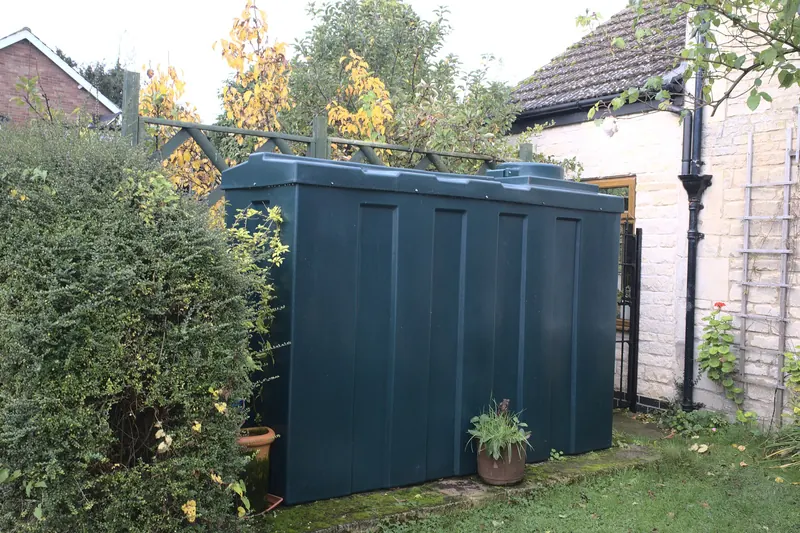
The distances come from the Scottish building standards, in the part of the Technical Handbook (Domestic) that deals with protecting stored fuel from fire. They apply to tanks of up to 3,500 litres, which covers nearly every kerosene tank beside an Ayrshire house or steading.
The closer the tank sits to the house or the boundary, the more fire protection it needs.
What are the distances?
The two numbers to remember are 1.8m from any part of a building and 760mm from a boundary. Table 3.24 in standard 3.23 of the Technical Handbook (Domestic), April 2026 sets out what each position needs:
- More than 1.8m from any building and more than 760mm from a boundary: a non-combustible base.
- More than 1.8m from any building but within 760mm of a boundary: a non-combustible base, plus a barrier or a wall of non-combustible construction.
- Within 1.8m of a building: a non-combustible base, non-combustible eaves within 1.8m of the tank (running 300mm past each side of it), and a barrier, or for a wall with no openings, that part of the wall built of non-combustible construction.
- Wholly below ground outside: no fire protection needed.
Tanks over 3,500 litres follow a British Standard (BS 5410 Part 2) instead of the table.
What counts as a fire barrier?
A barrier is a solid, non-combustible wall or screen with no holes in it. The handbook asks for it to stand at least 300mm higher than the tank and to run 300mm beyond each end, so that heat cannot shine straight onto the tank.
A timber fence, a hedge or a trellis screen is not a fire barrier. If you have planted round the tank to hide it, see how to stop heating oil being stolen, which covers screening that still leaves room for fire safety and deliveries.
What should the tank stand on?
The base should be solid and in full contact with the ground. The handbook gives concrete at least 100mm thick or paving slabs at least 42mm thick, extending at least 300mm beyond every side of the tank. Near a boundary, where the tank is within 1m of it and close to a barrier or non-combustible wall, the base only needs to reach that wall.
The same section asks for a fire valve on the oil feed to the boiler, and copper or steel pipe for the oil line inside the house. Both are jobs for an OFTEC-registered technician.
Does distance from water matter too?
Yes, but for pollution rather than fire. A tank within 10m of a burn, loch or the sea, or within 50m of a spring or borehole, should be bunded under standard 3.24 on fuel containment. That is explained in does my oil tank need a bund.
Theft is the third pull on where a tank goes. Police Scotland's advice after a heating fuel theft suggests siting the tank, where you can, so it can be seen from the house.
Do we need permission to move it?
Moving or replacing a tank is alteration work, and the tank must then meet the building regulations, as SEPA's general binding rule on storage of oil on a private dwelling requires for house tanks of up to 2,500 litres. OFTEC's guide notes that in Scotland you may need to apply for a building warrant; your council's building standards team can say for certain.
What to look at first
- The distance from the tank to the nearest wall, window, door and eaves.
- The distance to the property boundary.
- What the tank stands on and how far the base reaches past it.
- Whether any wall, fence or hedge between tank and house is combustible.
- Where the oil line enters the house.
Yours to do, and theirs
You can
- Measure the distances and photograph the tank and its base.
- Keep logs, bins, garden furniture and dry plant growth away from the tank.
Leave to them
- Moving a tank, building a barrier wall or laying a new base is for an OFTEC-registered technician.
- Whether a warrant is needed is for your council's building standards service.
| Where the tank is | Base | Extra protection |
|---|---|---|
| More than 1.8m from buildings, over 760mm from boundary | Non-combustible | None |
| More than 1.8m from buildings, within 760mm of boundary | Non-combustible | Barrier or non-combustible wall |
| Within 1.8m of a building | Non-combustible | Non-combustible eaves plus a barrier in most cases |
| Wholly below ground | Not needed | None |
Safety first
Do not move, lift or cut into an oil tank yourself, even an empty one, as oil vapour can remain inside. If you smell oil or see a stain round the base, follow what to do if heating oil leaks.
In short
Keep a house oil tank more than 1.8m from the building and more than 760mm from the boundary, on a non-combustible base, and it needs no other fire protection. Closer than that, it needs a barrier or non-combustible construction. Water nearby brings separate bund rules.
Also asked about this
Can the oil tank go in the garage?
The handbook allows it only with extra measures: the space treated as a special fire risk, ventilated to outside, with an outward-opening door and a catchpit. That is a job for an OFTEC-registered technician to design.
Does the 1.8m count from a window or from the wall?
The handbook measures from any part of a building, and treats a wall with openings more strictly, asking for a barrier rather than just non-combustible construction.
Our neighbour's tank is right on the boundary. Is that allowed?
Within 760mm of a boundary, the handbook asks for a barrier or non-combustible wall as well as the base. The council's building standards service deals with concerns about a neighbour's installation.
Do these rules apply to a small tank for a range cooker?
Standard 3.23 covers tanks over 90 litres that serve a fixed heating or cooking appliance, so a cooker tank of that size is included.
Sources, checked 5 November 2026
- Scottish Government — Technical Handbook (Domestic), April 2026, 3.23 Fuel storage – protection from fire
- Scottish Government — Technical Handbook (Domestic), April 2026, 3.24 Fuel storage – containment
- SEPA — Storage of oil on a private dwelling (general binding rule)
- OFTEC — Your home guide to liquid fuel heating
- Police Scotland — Appeal after heating fuel stolen in Kirkwall