Asked about damp and the sea air
Does salt air damage a heat pump's outdoor unit?
Answered by Asked in Ayrshire · Updated · Sources at the foot
Salt air can damage a heat pump's outdoor unit, because salt spray and damp onshore wind speed up corrosion of its metal parts, so coastal models, careful siting and regular checks matter near the shore.
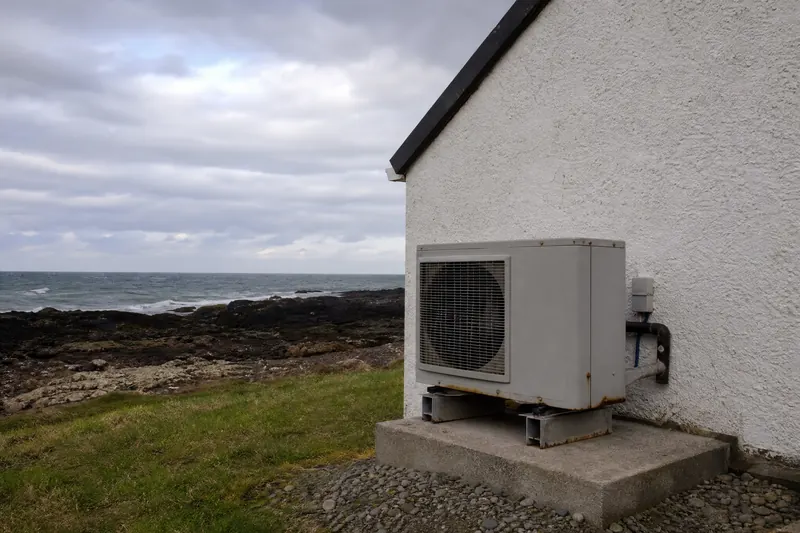
An air source heat pump's outdoor unit is a metal box full of thin fins, a fan and a coil, working outside all year. On the Ayrshire coast, from Largs down past Troon and Ayr to Girvan, it sits in wind that carries salt off the Firth of Clyde.
That doesn't mean a heat pump is a bad choice by the sea. It means the model, the spot and the upkeep need more thought than they would inland.
How does salt cause the damage?
Salt settles on metal and holds moisture there. Mitsubishi Electric's product note on its coastal Ecodan models says salt spray from breaking waves and onshore winds significantly speeds up corrosion of metal parts. It explains that the salt, mainly sodium chloride, builds up on metal surfaces, and that the high humidity of coastal areas adds to the corrosion rate: the longer a surface stays damp, the faster it corrodes.
The same note says onshore winds carry both salt and moisture inland. So a house a little way back from the beach can still be exposed, which is also part of why a house by the sea is so damp.
Are there coastal versions of heat pumps?
Some makers offer them. Mitsubishi Electric describes coastal protection models, marked "-BS", with external panels treated with acrylic resin and other key parts given extra protection, and says performance is unchanged. Its note includes a chart of recommended models by distance from the sea and by whether the coil faces the sea or inland, with the coastal versions advised for units facing the sea.
Whatever make your installer suggests, ask which version suits your distance from the shore and how the unit will face, and ask to see the maker's guidance in writing.
Where should the outdoor unit go?
Mitsubishi Electric's tips for coastal installations are to avoid direct exposure to sea spray where possible, to let rain fall on the unit rather than placing it right under the eaves, and to install it level so it drains well.
Home Energy Scotland adds that the unit must be unobstructed with enough space for good airflow, and suggests keeping it away from bedroom windows in quiet areas. Planning rules matter too: under Scotland's householder permitted development rights, one air source heat pump is generally allowed, but not within the grounds of a listed building, and in a conservation area it must be at ground level on the rear wall.
How do we look after it by the sea?
Mitsubishi Electric recommends regular inspection and washing of the unit with fresh water in coastal sites, and repairing any scratches promptly. Ask your installer to show you what, if anything, you can safely do yourself, and leave anything that needs panels removed or the power isolated to them.
Home Energy Scotland's guide to living with a heat pump says to keep the fins free of debris such as fallen leaves, and to have the heat pump serviced annually by a certified engineer, most easily through an MCS-certified company. Follow the maker's or installer's guidance to keep warranties valid.
If you are still weighing up a heat pump, see should we swap the oil boiler for a heat pump and will a heat pump work in a stone cottage.
What to look at first
- How far the unit is from the shore, and whether it faces the sea.
- Whether the model is a coastal or standard version (check the model label or paperwork).
- Rust spots, flaking paint or scratches on the casing.
- The fins: bent, blocked with leaves or crusted with salt?
- Whether the unit sits level and drains freely.
Yours to do, and theirs
You can
- Look the unit over after storms and keep leaves and debris away from the fins.
- Keep a note of rust spots or scratches to show at the service.
- Ask your installer how, and how often, the unit should be rinsed on your site.
Leave to them
- Choosing a coastal model and siting it is for an MCS-certified installer.
- Servicing, cleaning the coil and repairing the casing is for a certified heat pump engineer.
| Choice | Better | Worse |
|---|---|---|
| Model | Coastal-protected version for sea-facing sites | Standard model facing the sea |
| Position | Sheltered from direct spray, rain can reach it | Right under the eaves, out of the rain |
| Mounting | Level, draining freely | Tilted, water sitting in the base |
| Upkeep | Regular checks and servicing | Left until it fails |
Safety first
Don't remove panels from the outdoor unit or spray water into it while it is powered; it has live electrical parts. Leave internal cleaning and repairs to a certified heat pump engineer.
In short
Salt spray and damp sea air speed up corrosion on a heat pump's outdoor unit. A coastal-protected model, a spot sheltered from direct spray but open to rain, and regular checks and servicing all help it last on an exposed Ayrshire site.
Also asked about this
How far from the sea does salt stop being a problem?
There is no single distance. Mitsubishi Electric's chart depends on distance, obstructions such as other houses, and whether the coil faces the sea, so ask your installer for the maker's advice.
Does salt air affect the heat pump's efficiency?
Mitsubishi Electric says its coastal models have no change in performance. Home Energy Scotland stresses keeping the fins clear so nothing blocks the airflow.
Do we need planning permission for a heat pump on a listed cottage?
Permitted development does not cover the grounds of a listed building, so speak to your council's planning service first.
How often should a heat pump be serviced?
Home Energy Scotland advises an annual service by a certified engineer in its guide to living with a heat pump. Follow the maker's schedule for your model.
Sources, checked 5 November 2026
- Mitsubishi Electric — Ecodan coastal protection models (-BS) product information
- Home Energy Scotland — 11 heat pump myths
- Home Energy Scotland — Living with your heat pump
- Scottish Government — Planning circular 1/2024: householder permitted development rights, 6. Installing microgeneration equipment
- Home Energy Scotland — Heat pump installation checklist and guide