Asked about the water supply
Do we need a UV unit on our private supply?
Answered by Asked in Ayrshire · Updated · Sources at the foot
Yes, most private supplies need a UV unit or another form of disinfection, because mygov.scot says a private supply will always need disinfection to kill harmful bacteria, and UV only works on clear, pre-filtered water.
A spring that tastes fresh and looks clear can still carry bacteria from sheep, deer or birds on the hill. Disinfection is the barrier between what lands on the catchment and what comes out of the kitchen tap.
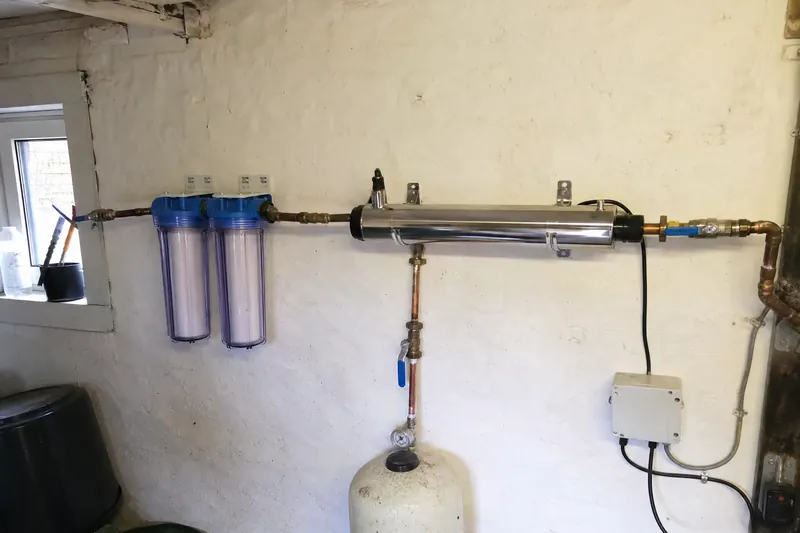
UV is the most common choice on Ayrshire farm supplies because it adds nothing to the water. But a UV unit is only as good as the water reaching it and the care it gets.
Why is disinfection needed at all?
mygov.scot says plainly that you must treat water to make it safe, and that a private supply will always need a disinfection treatment to kill harmful bacteria. The Drinking Water Quality Regulator adds that outbreaks of disease in Scotland have been linked to private supplies.
A UV unit uses UV lamps to kill bacteria and doesn't change the taste. Chlorine or chlorine dioxide are the alternatives, and mygov.scot notes they need a specialist to install.
Will UV work on our water?
Only if the water is clear. The regulator's UV guidance treats pre-filtration as a prerequisite, says turbidity needs to be below 1 NTU, and warns that water with any visible colour is unlikely to be suitable for UV.
On peaty Ayrshire uplands that matters, because colour can jump after rain, as our page on brown spring water explains. Iron and manganese also reduce UV effectiveness, so a lab test should come before buying anything.
What does a UV unit need to keep working?
Regular care. The regulator says most low-pressure lamps last about 9,000 hours, roughly a year, and that a sensible starting point for cleaning the quartz sleeve is monthly where there is no automatic cleaning.
It also recommends linking monitors to an alarm so a failed lamp is obvious, and notes alarms can be linked to the pump so undisinfected water can't be supplied. mygov.scot's maintenance page lists cleaning UV filters, replacing bulbs and replacing dirty or blocked filters as routine maintenance. The lamp and sleeve sit inside a mains-powered unit, so book lamp changes and sleeve cleaning with the installer or a service technician. Your part is to note the dates, watch the alarm or indicator and book the service on time.
Does UV protect the water all the way to the tap?
No. UV leaves no lasting disinfectant in the water, the regulator says, so anything that gets in after the unit, such as a dirty storage tank, isn't treated. Fit the unit where it treats water close to the point of use, and keep tanks covered and clean.
UV kit is one of the things the private supply grant can help pay for. A test from the council is the sensible first step.
What to look at first
- Is there any disinfection on the supply at present?
- Is the water clear, or does it colour after rain?
- Are there pre-filters before the UV unit, coarsest first?
- When were the lamp and quartz sleeve last changed or cleaned?
- Does the unit have a working alarm or indicator?
Yours to do, and theirs
You can
- Clean or change pre-filter cartridges when dirty or blocked, and keep spares.
- Note the lamp and sleeve service dates and book the next visit about a year on.
- Check the alarm or indicator light weekly, and call the service technician if it shows a fault.
Leave to them
- The installer or a service technician sizes and fits the UV unit, changes the lamp and cleans the quartz sleeve.
- The council's environmental health team tests the water before and after.
- An electrician handles any new wiring for the unit or alarm.
| Item | What the guidance says | Who does it |
|---|---|---|
| Pre-filtration | A prerequisite for UV to work consistently | Replace cartridges when dirty |
| Water clarity | Turbidity below 1 NTU, no visible colour | Note changes after rain |
| Lamp | About 9,000 hours, roughly a year | Service technician; you note the date and book it |
| Quartz sleeve | Clean monthly if no automatic cleaning | Service technician; you book the visits |
Safety first
Don't open a UV unit or handle the lamp or quartz sleeve yourself: lamp changes and sleeve cleaning are for the installer or a service technician, and any wiring is for an electrician. Beyond checking the unit's switch is on, leave the electrics alone. If the alarm shows a failed lamp, use boiled or bottled water for drinking until it is fixed.
In short
Almost every private supply needs disinfection, and UV is the usual choice. It only works on clear, filtered water, needs a yearly lamp change and regular sleeve cleaning booked with a service technician, a working alarm, and should follow a proper council test.
Also asked about this
Can we fit a UV unit ourselves?
mygov.scot says choosing treatment is best left to a specialist, and any new electrical supply is a job for an electrician.
Does UV remove iron or peat colour?
No. UV disinfects; it doesn't remove colour, iron or manganese, which reduce its effect and need treatment ahead of it.
Does a UV unit kill Cryptosporidium?
The regulator says UV can be effective against Cryptosporidium and Giardia with a sufficient dose and contact time.
Should the UV go before or after a pH filter?
mygov.scot says pH correction goes between any filters and your disinfection treatment, so the UV comes last.
Sources, checked 5 November 2026
- mygov.scot — Treating a private water supply
- mygov.scot — Maintaining a private water supply
- Drinking Water Quality Regulator for Scotland — Disinfection by UV radiation
- Drinking Water Quality Regulator for Scotland — Private water supplies
- Drinking Water Quality Regulator for Scotland — Colour
- mygov.scot — Apply for a private water supply grant