Asked about grants, rules and paperwork
Do we need a building warrant to change the heating?
Answered by Asked in Ayrshire · Updated · Sources at the foot
Most heating changes in a Scottish house do not need a building warrant, but a new oil tank over 90 litres, work on a chimney, flue-pipe or hearth, and large boilers fall outside the exemption.
In Scotland, the rules sit in the Building (Scotland) Regulations 2004 and the Technical Handbooks (Domestic). Schedule 3 to the regulations lists the work that does not need a warrant, and the handbook explains it type by type. The current domestic handbook, the April 2026 edition, applies to warrants submitted on or after 6 April 2026.
One point catches people out: exempt work still has to meet the building regulations. The handbook's section on work not requiring a warrant says such work must still comply. No warrant does not mean no rules.
Does replacing a boiler need a warrant?
Usually not for a typical house boiler. Schedule 3 type 6 exempts work on a combustion appliance installation or other part of a heating installation, except for a solid fuel appliance over 50kW, an oil-firing appliance over 45kW, or a gas-fired appliance over 70kW net input. Note that the separate like-for-like replacement exemption (type 24) excludes oil and gas boilers, so a boiler swap relies on type 6 and its limits rather than on being "like for like".
The installer must still be competent: Gas Safe registered for LPG, OFTEC-registered for oil. The handbook's section on combustion appliances names those registration schemes.
Does a new oil tank need a warrant?
It can. Type 6 does not cover any work associated with an oil storage tank of more than 90 litres, so a new or moved domestic tank falls outside the exemption. Ask the council's building standards team before the tank is ordered. Siting rules are in how close can an oil tank be to the house.
What about a stove, flue or chimney?
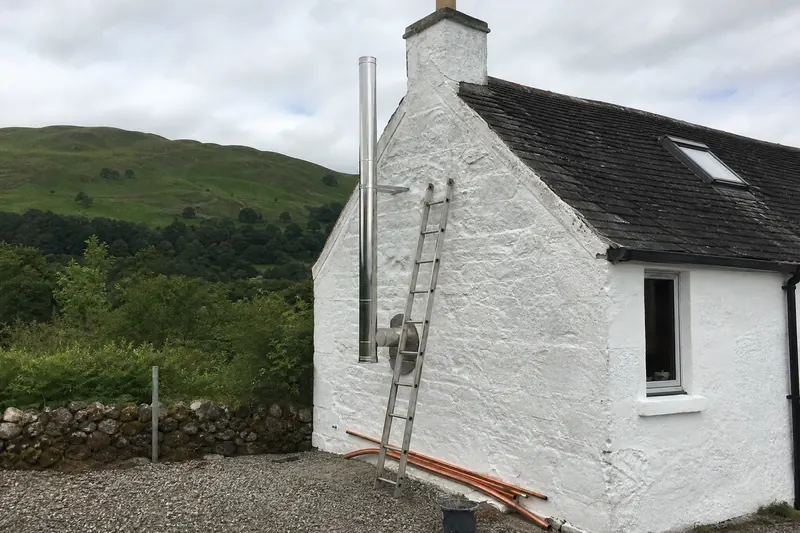
Type 6 also excludes any work associated with a chimney, flue-pipe or constructional hearth. Fitting a flue liner on its own is listed as exempt (type 9), and so is a balanced flue serving a room-sealed appliance (type 7). A new stove with a new hearth or flue-pipe is the case to check; see can we keep using our wood-burning stove.
Does a heat pump need a warrant?
The Schedule 3 list does not name heat pumps, so there is no clear exemption to quote. Pipework, radiators, convector heaters and thermostatic controls are exempt under type 8, which covers much of the indoor work. Ask your council's building standards team about the specific installation, and ask the planning team separately about the outdoor unit. More on the heat pump choice is in should we swap the oil boiler for a heat pump.
How do we apply if we do need one?
mygov.scot says you apply online through the eDevelopment portal, with plans showing where the work is and what it involves. The fee depends on the value of the work. Your local council's building standards department answers questions; in Ayrshire that is East, North or South Ayrshire Council depending on your address.
What to look at first
- The boiler's output rating, on its data plate or in the manual.
- The size of any new oil tank, in litres.
- Whether a chimney, flue-pipe or hearth is being built or altered.
- Whether the house is listed or in a conservation area.
- The installer's registration: Gas Safe, OFTEC, HETAS or MCS.
Yours to do, and theirs
You can
- Ask the council building standards team before signing up to a new tank, stove or flue.
- Keep the installer's certificates and paperwork with the house deeds and home report papers.
Leave to them
- A Gas Safe, OFTEC or HETAS registered installer does the fuel and flue work.
- The council's building standards team decides whether a warrant is needed.
| Job | Schedule 3 position | Check with council? |
|---|---|---|
| Replace boiler up to 45kW (oil) or 70kW (gas) | Exempt under type 6 | Only if unsure |
| New oil tank over 90 litres | Not exempt | Yes |
| New chimney, flue-pipe or hearth | Not exempt | Yes |
| Radiators, pipework, thermostatic controls | Exempt under type 8 | No |
| Heat pump | Not named in the list | Yes |
In short
Swapping a normal-sized boiler or radiators rarely needs a building warrant, but the work must still meet the regulations. A new oil tank, new chimney or flue work, and heat pumps are the jobs to raise with the council's building standards team before anything is ordered.
Also asked about this
Who decides if a warrant is needed?
Your local council's building standards department; in Ayrshire, the council for your address.
Can work start before a warrant is granted?
Where a warrant is needed, wait for it before starting. If you are unsure whether one is needed, ask first.
Do we need a warrant to move a radiator?
Pipework and radiators are exempt under type 8, though the work must still meet the regulations.
Does the warrant matter when we sell?
Missing paperwork can come up when the house is sold, so keep warrants and completion papers together; see what happens to the septic tank when we sell for a similar sale-time check.
Sources, checked 5 November 2026
- Scottish Government — Building standards technical handbook: domestic, April 2026
- Scottish Government — Technical Handbook (Domestic), April 2026, 0.5 Work not requiring a warrant
- Scottish Government — Technical Handbook (Domestic), April 2026, 3.17 Combustion appliances, safe operation
- Scottish Government — Technical Handbook (Domestic), April 2026, 3.23 Fuel storage, protection from fire
- mygov.scot — Building warrant
- legislation.gov.uk — Building (Scotland) Regulations 2004, Schedule 3